Does a sauna help you sleep?
The equinox lands on 22 September. From then on, Utah loses daylight at both ends until December, and the hour that goes first is the one most people used to wind down in.
The honest answer is that the heat does not make you sleepy — the cool-down afterwards does. Core temperature rises, then falls once you step out, and that fall is one of the cues the body reads as bedtime. It is why evening sessions suit most owners better than morning ones.
There is decent evidence behind that mechanism, with one caveat worth naming. A systematic review of passive body heating before bed found that warming yourself one to two hours before sleep shortened the time it took to fall asleep and improved self-reported sleep quality (Haghayegh et al.). The caveat is that those trials used warm showers and baths, not saunas — the heating route is different even if the temperature curve is similar. A separate review of dry sauna bathing reports better sleep among regular bathers, but largely from self-reported data rather than controlled trials (Hussain and Cohen).
Two things matter about as much as the physiology. The first is the walk: twenty feet across the yard in the cold, then heat. Short enough to still do in November, long enough to count. The second is that it is twenty minutes where nobody asks you anything. Owners describe that before they describe the health benefits.
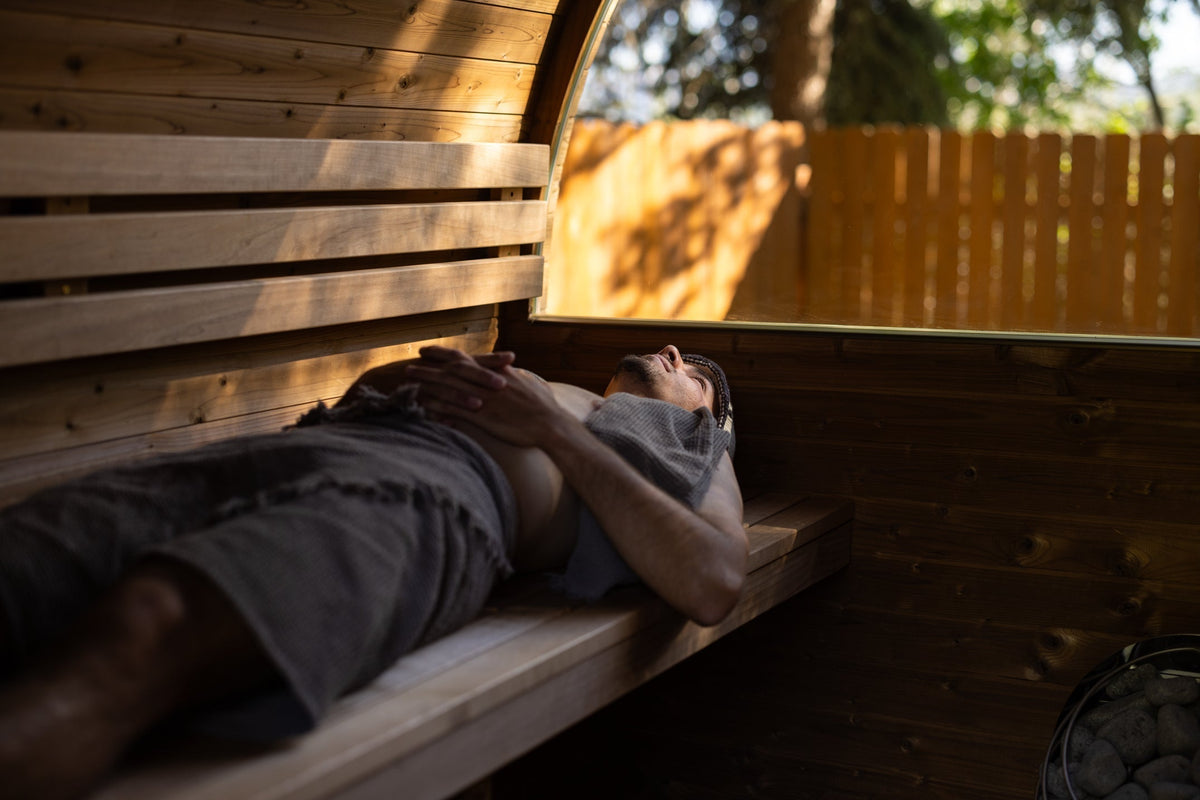
Timing is the one thing worth being deliberate about. Most owners land on finishing an hour or so before bed — long enough for the cool-down to run its course, close enough that the calm has not worn off. A session that ends five minutes before you get into bed tends to keep you up rather than settle you.
Two practical notes for Utah in particular, based on what our owners have told us. The air here is dry to begin with, so water on the stones matters more than it would at sea level, and so does drinking more than you think you need. And at elevation the first week feels heavier than the second — shorter rounds until your body catches up is not a failure of nerve.
Give it two weeks before you judge it. The pattern owners report is that the sessions themselves stop feeling like an event around day ten, which is roughly when the habit stops requiring a decision — and that, more than any single night's sleep, is the thing worth buying.
This month's ritual:
Three rounds, cold between
Fifteen minutes in, two minutes cold, five minutes resting. Repeat three times. Water on the stones at the start of each round, not throughout — the löyly is meant to arrive, not linger.
Sources:
Haghayegh, Shahab, et al. “Before-Bedtime Passive Body Heating by Warm Shower or Bath to Improve Sleep: A Systematic Review and Meta-Analysis.” Sleep Medicine Reviews, vol. 46, 2019, pp. 124–35.
Hussain, Joy, and Marc Cohen. “Clinical Effects of Regular Dry Sauna Bathing: A Systematic Review.” Evidence-Based Complementary and Alternative Medicine, vol. 2018, 2018, pp. 1–30.
We build saunas — we are not health professionals, and none of this is medical advice. Please talk to your doctor before using a sauna, especially if you are pregnant or managing an underlying condition.